STEM Education in Tokyo is evolving rapidly, but one of the most important conversations happening today is not just about coding, robotics, or engineering. It is about movement. Research continues to show that physical activity plays a powerful role in improving focus, memory, creativity, and problem-solving skills in children. When movement and learning work together, children thrive both inside and outside the classroom.
At Mirai Minds, we believe the future of learning is interdisciplinary. Children learn best when they are engaged mentally, physically, emotionally, and socially. That is exactly why our Robo Dojo Summer Camp combines robotics, engineering, and martial arts inspired physical training into one immersive experience.
How Physical Activity Strengthens STEM Education in Tokyo
The connection between movement and cognitive performance is backed by neuroscience. Physical activity increases blood flow to the brain, improves neural connectivity, and enhances executive functioning. These are the same cognitive skills children rely on for STEM learning.
Executive functioning includes attention control, working memory, planning, and flexible thinking. Whether a child is solving a robotics challenge or learning to debug a coding sequence, these mental skills are essential.
Studies have also shown that children who engage in regular physical movement often demonstrate improved academic performance in mathematics and science. Activities that involve coordination, discipline, and repetition help strengthen concentration and mental endurance. This is particularly important in modern STEM Education in Tokyo, where students are often balancing rigorous academics with creative problem solving.
Why Martial Arts and Robotics Make a Powerful Combination
At first glance, karate and robotics may seem like completely different worlds. One is physical and disciplined, while the other is analytical and technical. However, both require precision, focus, consistency, and resilience.
In martial arts, children learn body awareness, patience, reaction time, and self-control. In robotics, they learn logical sequencing, engineering principles, experimentation, and innovation. Together, these disciplines help children build a growth mindset.
This integrated approach is becoming increasingly valuable in STEM Education in Tokyo because future careers will require adaptability, emotional intelligence, teamwork, and critical thinking alongside technical skills.
At Robo Dojo Summer Camp, children are encouraged to move between physical and intellectual challenges throughout the day. This balance helps prevent mental fatigue while keeping curiosity and motivation high.
The Science Behind Movement and Memory
One of the most fascinating aspects of physical activity is its impact on memory retention. Exercise stimulates the release of brain-derived neurotrophic factor, often called BDNF, which supports the growth and maintenance of brain cells.
For children learning STEM concepts, this matters enormously. Improved memory retention can help children absorb mathematical concepts faster, remember coding structures more effectively, and stay engaged during problem-solving activities.
Physical movement also reduces stress and anxiety, which are often barriers to learning. Children who feel physically confident and emotionally regulated are more likely to take intellectual risks and approach challenges with confidence.
This is why modern STEM Education in Tokyo is beginning to embrace more holistic learning environments that prioritize wellness alongside academics.
Building Future-Ready Skills Through Holistic Learning
The future belongs to children who can think critically, collaborate effectively, and adapt quickly. Technical knowledge alone is no longer enough. Children need opportunities to build resilience, confidence, communication skills, and creativity.
At Mirai Minds, we view STEM learning as more than academics. We see it as a pathway to developing capable, curious, and balanced young learners. Our programs help nurture the whole child through robotics engineering, karate-based physical training, and skill-building activities.
Our Robo Dojo Summer Camp gives children aged 4 to 12 the chance to explore real-world robotics projects while developing discipline, coordination, and confidence through movement-based learning.
Join the Robo Dojo Summer Camp at Mirai Minds
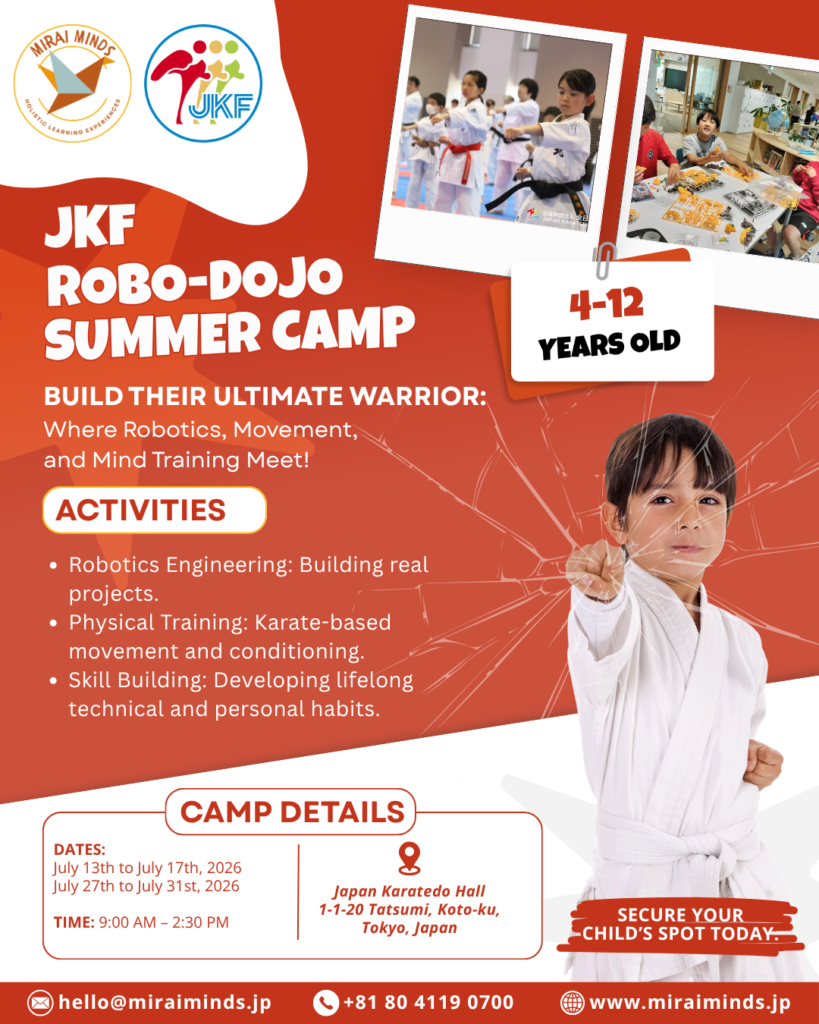
If you are looking for a unique approach to STEM Education in Tokyo, Robo Dojo Summer Camp offers children an exciting opportunity to build both mind and body skills in one engaging environment.
Hosted in collaboration with JKF at the Japan Karatedo Hall in Tokyo, the camp blends robotics engineering, physical conditioning, and lifelong skill development into a truly future-focused experience.
Children will build real projects, strengthen focus and confidence, and discover how movement and technology can work together to unlock their potential.
Spaces are limited, so secure your child’s spot today and give them a summer where innovation meets action with Mirai Minds Robo Dojo Summer Camp.