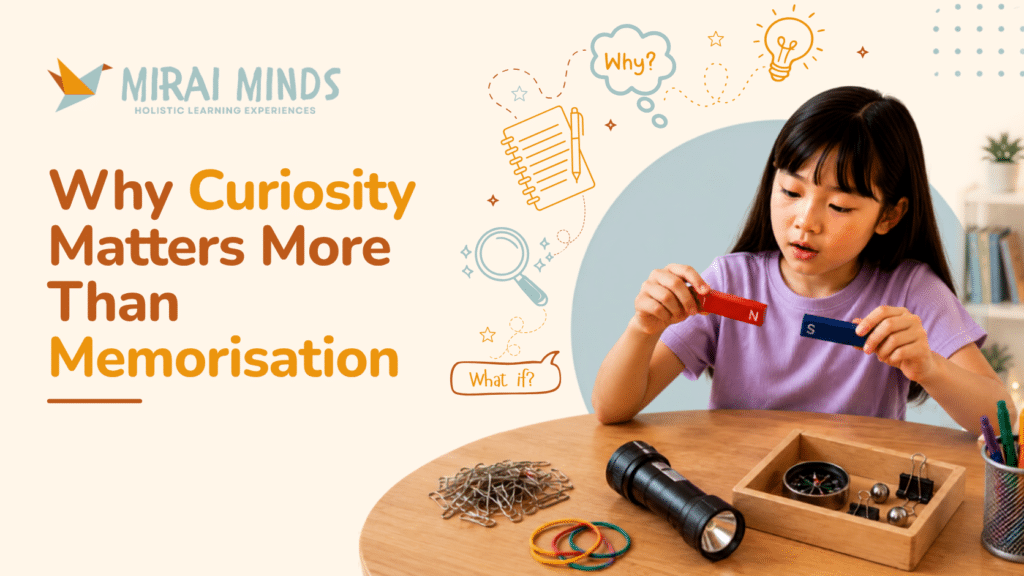
Every breakthrough in history began with a question. What if gravity isn’t pulling the apple down? What if disease isn’t caused by bad air? Or what if people could communicate across continents in seconds? Long before there were discoveries, inventions or breakthroughs, there was curiosity in children, and the willingness to wonder whether something could be understood differently.
Children naturally possess this instinct. They ask why the sky changes colour, how a robot knows where to go, what would happen if two things were combined, and whether something could work in a completely different way. Their questions can seem endless, but beneath that constant curiosity in children is something incredibly important: a natural drive to understand the world around them.
As children move through their education, however, questions can gradually become secondary to answers. Classrooms have traditionally placed considerable emphasis on accuracy, measurable outcomes and arriving at the correct solution. These things matter, but when learning becomes too focused on finding the right answer, we can sometimes overlook one of the most powerful forces that makes children want to learn in the first place: curiosity.
What Does Research Tell Us About Curiosity in Children?
Curiosity in children isn’t simply a nice quality to have. Research suggests that it can influence how effectively we learn and remember information.
In a study published in Neuron, researchers Matthias Gruber, Bernard Gelman and Charan Ranganath examined what happens in the brain when people become curious about the answer to a question. They found that participants remembered information they were curious about more effectively, while states of high curiosity were also associated with increased activity in brain regions involved in reward, motivation and memory. The study suggests that curiosity can help create conditions that are particularly favourable for learning.
This helps explain something parents and educators see all the time. When a child genuinely wants to know something, they rarely need to be persuaded to learn about it. They ask another question, look for another explanation and often keep exploring long after they have received the initial answer. The motivation comes from within. The question itself becomes the starting point for deeper learning.
A Question Can Be the Beginning of Much Bigger Learning
Consider a child working with a robot for the first time. They can be shown exactly how to programme it, follow a set of instructions and arrive at the expected result. But what happens when the child is encouraged to experiment instead? Why did the robot turn that way? What would happen if we changed the code? Could it move faster? Could we make it do something completely different?
Suddenly, the activity is no longer only about learning how to programme a robot. It becomes an opportunity to investigate, test ideas, solve problems and learn from failure. The child is developing knowledge, but they are also developing the habit of looking at a problem and asking, “What else could be possible?”
That distinction matters because the world children are growing up in is changing rapidly. Information is now available almost instantly, which means that simply remembering facts is no longer enough. What becomes increasingly valuable is the ability to ask meaningful questions, evaluate information, identify patterns, challenge assumptions and work out what to do when there isn’t an obvious answer.
Curiosity in Children and the Skills of the Future
The connection between curiosity and future-ready learning becomes even more relevant when we look at what employers say they need. The World Economic Forum’s Future of Jobs Report 2025, based on responses from more than 1,000 employers representing over 14 million workers, identifies analytical thinking as the most widely recognised core skill, while creative thinking, curiosity and lifelong learning also feature prominently. The report also identifies curiosity and lifelong learning, alongside creative thinking and resilience, as skills expected to continue increasing in importance through 2030.
These are not skills that develop simply by memorising information. They grow when children are given opportunities to explore, experiment, question and try again.
You cannot investigate a problem without first wondering about it. You cannot challenge an assumption without first questioning it. Or develop a new solution without first imagining that there might be another way.
This is why curiosity sits so closely alongside critical thinking, creativity and problem-solving. It is often the starting point for all three.
What Does a Curious Learning Environment Look Like?
Creating a curious learning environment doesn’t mean removing structure or academic rigour. It can be as simple as giving children opportunities to predict before revealing the outcome, encouraging them to find multiple solutions to a problem, allowing them to experiment with ideas that might not work, and exploring their unexpected questions together.
These experiences teach children that not knowing something is not a weakness. It is often the beginning of discovery.
A science experiment becomes more meaningful when a child makes a prediction before seeing the result.
A robotics challenge becomes more engaging when there isn’t just one way to solve the problem. A creative project becomes more valuable when children have the freedom to make choices, make mistakes and rethink their approach.
In each case, the goal isn’t simply to arrive at the correct answer. It is to develop the thinking that helps a child get there.
Preparing Children for a Future We Cannot Predict
We don’t know exactly what the world of work will look like when today’s children become adults. Some of the jobs they eventually enter may not even exist yet. Technologies will change, new problems will emerge and the skills that matter most will continue to evolve.
What we can give children is not a list of answers for every possible future. We can give them the confidence to keep learning when those answers are no longer available to them.
The World Economic Forum’s findings reinforce this idea: as technology continues to reshape work, human capabilities such as analytical thinking, creative thinking, adaptability, curiosity and lifelong learning remain important alongside technological skills.
Perhaps, then, one of the most important questions we can ask about education is not simply how many answers a child knows, but whether they still feel excited by the questions they haven’t answered yet.
Because learning isn’t only about helping children understand what we already know. It is to give them the confidence to explore what isn’t, to question what could be different and to imagine what might be possible.
At Mirai Minds, we believe children learn more meaningfully when they ask questions, experiment with ideas and discover answers for themselves.Through hands-on experiences in STEM, robotics, entrepreneurship, fitness and creative learning, our programmes help children build curiosity, confidence and future-ready skills that extend far beyond the classroom.
Want to give your child more opportunities to explore, create and ask “What if?” Discover Mirai Minds’ afterschool programmes in Tokyo and see where curiosity can take them.
Research & Further Reading
World Economic Forum. (2025). Skills Outlook: The Future of Jobs Report 2025. Explore the skills findings
Gruber, M. J., Gelman, B. D., & Ranganath, C. (2014). States of Curiosity Modulate Hippocampus-Dependent Learning via the Dopaminergic Circuit, Neuron, 84(2), 486–496. Read the research via PubMed
World Economic Forum. (2025). The Future of Jobs Report 2025. Read the full report