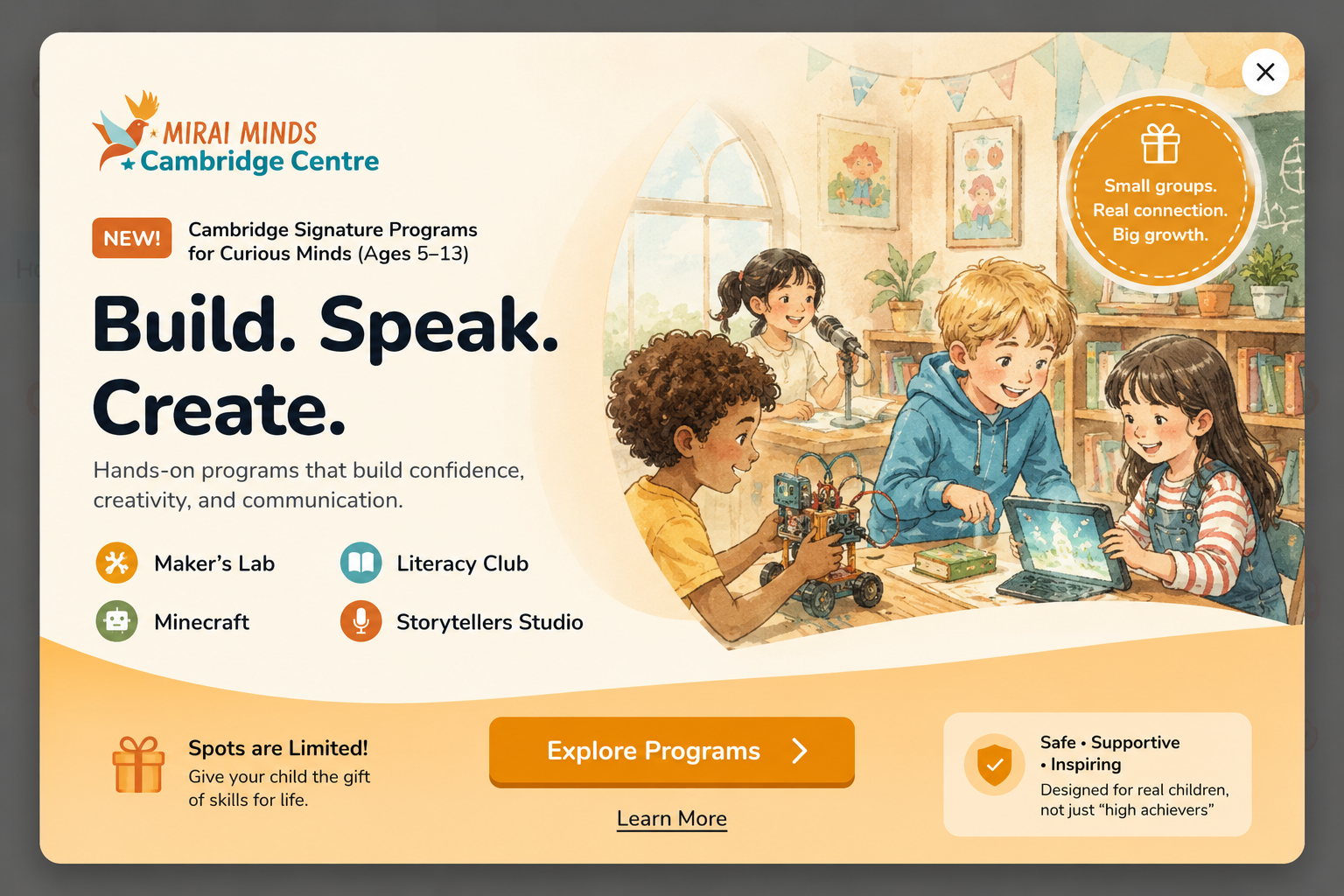
When parents hear the words STEM learning in Japan, they often picture coding classes, robotics kits or expensive science experiments.

While these activities can certainly spark curiosity, they are not the only way children develop STEM skills. In fact, some of the most valuable learning happens during ordinary moments at home.
Research from the National Research Council describes STEM as more than learning science or mathematics. At its core, STEM is about developing habits of mind: observing, asking questions, testing ideas, solving problems and learning from mistakes.
You don’t need specialised equipment to nurture these skills. Your home is already full of opportunities.
Here are five simple ways you can make STEM a natural part of everyday life.
1. Turn Everyday Tasks into Investigations
Cooking dinner, folding laundry or watering plants may not seem educational, but each activity offers opportunities to explore scientific and mathematical concepts.
While baking together, ask your child:
- What do you think will happen if we add more water?
- Why do we measure ingredients carefully?
- Why does the dough rise?
When hanging clothes to dry, ask:
- Which clothes do you think will dry first?
- Why do some fabrics absorb more water than others?
Instead of immediately giving the answer, encourage your child to make predictions first.
The goal isn’t to teach a lesson. It’s to build curiosity.
2. Ask More Questions Than You Answer
One of the biggest differences between simply giving information and developing critical thinking is the kind of questions we ask.
Instead of saying, “That’s because gravity pulls it down,” try asking:
- Why do you think it fell?
- What else could happen?
- How could we find out?
Children don’t need adults who always have the answers. They need adults who help them think.
Open-ended questions encourage observation, reasoning and confidence in exploring ideas independently.
3. Let Your Child Solve Small Problems
It can be tempting to jump in when your child struggles to build something or complete a puzzle.
Instead, pause.
Give them time to experiment, make mistakes and try again.
If a tower keeps falling over, resist rebuilding it for them. Ask:
- What do you notice?
- Which part seems unstable?
- What could you change?
This process of testing, adjusting and improving is exactly how engineers work.
Every small challenge helps children build resilience alongside problem-solving skills.
4. Encourage Observation During Everyday Walks
A walk to the park can become a science lesson without feeling like one.
Invite your child to notice patterns around them.
Can they spot different leaf shapes? Which birds visit the same trees? Why are some areas warmer than others? Why do shadows change throughout the day?
You can even turn observations into simple challenges:
- Find three things that float and three that sink when you get home.
- Count how many different insects you can find.
- Predict tomorrow’s weather based on today’s sky.
The objective isn’t perfect accuracy. It’s helping children learn to observe before drawing conclusions.
5. Celebrate Curiosity, Not Just Correct Answers
Perhaps the most important thing parents can do is change what they praise.
Instead of only celebrating when children get the right answer, celebrate the way they approached the problem.
Try saying:
- I like how many different ideas you tried.
- That was a clever question.
- You kept going even when it didn’t work the first time.
- I noticed how carefully you observed that.
When children learn that curiosity is valued, they become more willing to experiment, ask questions and take intellectual risks.
These are the qualities that prepare them not just for STEM subjects, but for life.
The Best STEM Tool Is Your Conversation
It’s easy to believe that better learning requires better resources.
But children learn just as much from conversations around the dinner table, questions during a walk and experiments in the kitchen as they do from specialised equipment.
The next time your child asks, “Why?” resist the urge to give a quick answer.
Ask, “What do you think?”
That single question can start a conversation that develops observation, reasoning and confidence all at once.
Because STEM isn’t something children switch on during a weekly class.
It’s a way of looking at the world.
And with a little curiosity, every home can become a place where that mindset grows.
If you’re looking for STEM learning in Japan that goes beyond textbooks and memorisation, Mirai Minds offers hands-on programmes designed to spark curiosity, creativity and critical thinking. Through engaging projects, real-world challenges and inquiry-based learning, children build the confidence and problem-solving skills they need for the future. Explore our STEM learning programmes in Japan and discover how your child can develop a lifelong love for learning.