Why Curiosity Matters More Than Memorisation
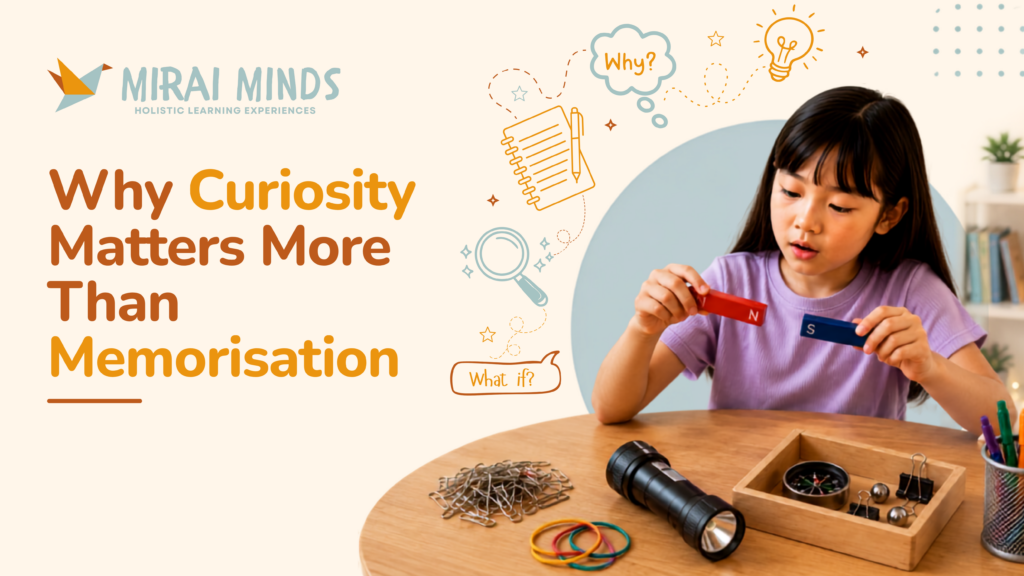
Children can memorise facts, repeat answers, and complete worksheets. But real learning begins when they start asking “Why?” “How?” and “What if?”
At Mirai Minds, we believe curiosity is one of the most important foundations of meaningful learning. Memorisation can help children remember information, but curiosity encourages them to explore, question, experiment, and understand.
Curiosity Turns Children Into Active Learners
When children are curious, they do not simply wait for an answer. They look for one.
A child who wonders why a plant grows toward sunlight may begin observing plants, asking questions, and testing ideas. This simple curiosity can lead to learning about science, nature, observation, and cause and effect.
That is why curiosity in children’s learning matters. Children become participants in their learning rather than simply receiving information.
Curiosity Builds Important Skills
Developing curiosity in children can support skills that are valuable far beyond the classroom.
Curious children naturally practise:
- Asking meaningful questions
- Exploring new ideas
- Making observations
- Testing possibilities
- Thinking creatively
- Solving problems
- Learning from mistakes
These experiences help children become more independent thinkers.
How Parents Can Encourage Curiosity
Parents do not need complicated activities to encourage curiosity. Sometimes, the best approach is simply to give children space to explore.
Instead of immediately answering a question, try asking:
“What do you think?”
“Why might that happen?”
“How could we find out?”
Open-ended conversations encourage children to think deeper and develop their own explanations.
Reading together, exploring nature, building things, conducting simple experiments, and allowing children to choose how they approach a task can also create opportunities for curiosity.
Curiosity at Mirai Minds
At Mirai Minds, learning is designed to go beyond memorising information. Through hands-on activities, exploration, STEM experiences, creative projects, and problem-solving challenges, children are encouraged to ask questions and discover answers.
Our goal is not simply to help children know more, but to help them become excited about finding out more.
Because when children are curious, learning does not stop when the lesson ends.
Curiosity keeps the learning going.